Salt arrives
Marine aerosol rides lagoon humidity through doors, windows and crawl-space air, then settles in the one spot no one ever wipes down: the condenser compartment behind the lower grille.

Journal essay · refrigerant law for 94404
Foster City wraps its neighborhoods around a 218-acre lagoon, and every waterfront Sub-Zero breathes that salt-tinged air across warm metal all day. This essay follows the chain from marine humidity to corroded sealed-system joints to a slow refrigerant leak — and explains why, once the leak is real, federal law decides whose hands may open the circuit: an EPA Section 608 certified technician who recovers the charge, repairs the joint, and only then recharges.
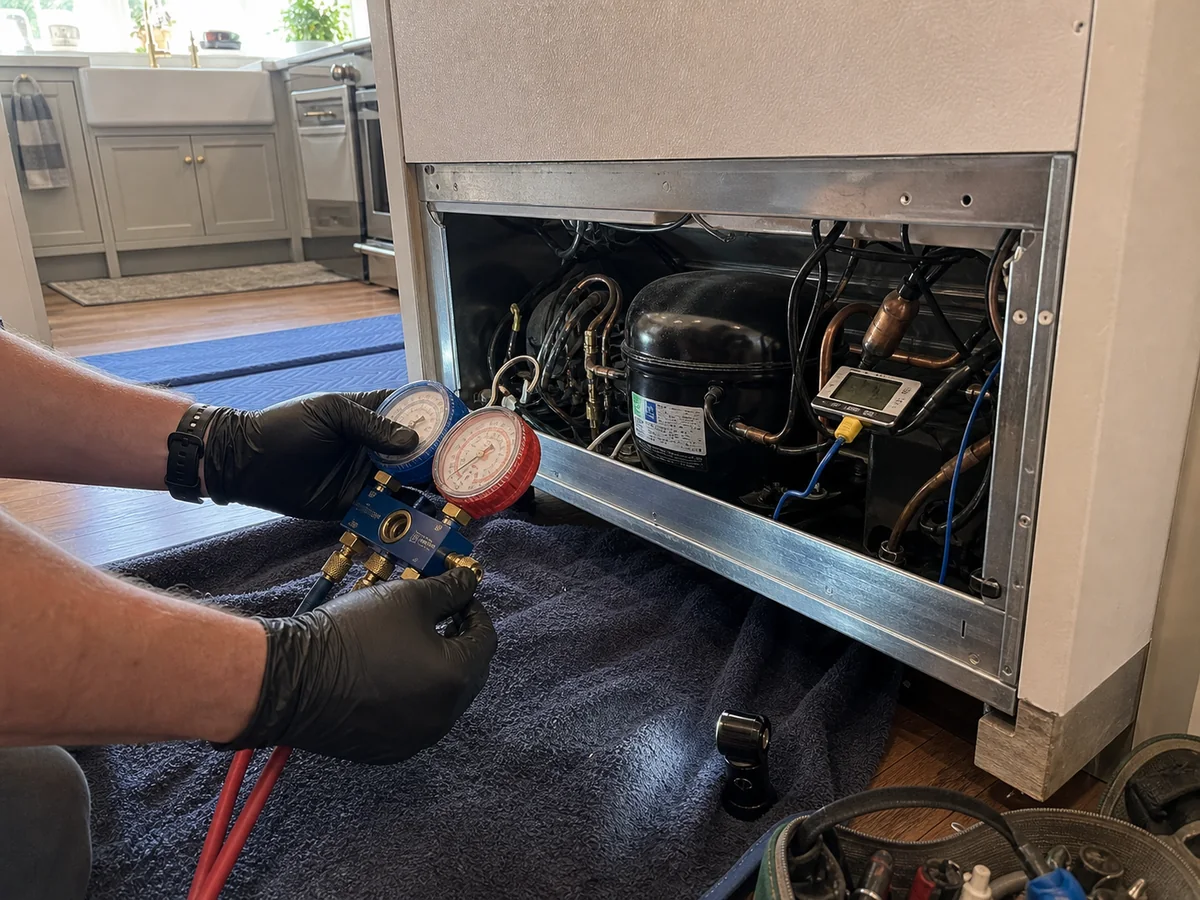
Only an EPA Section 608 certified technician. Under the Clean Air Act and 40 CFR Part 82, Subpart F, opening a Sub-Zero sealed refrigerant circuit in a Foster City kitchen — attaching gauges, cutting tubing or pulling a compressor — is a federally regulated act reserved for certified hands.
Stand on a Harbor Side dock before the fog lifts and the air tastes faintly of minerals — damp, cool, carried off the lagoon. Thirty feet away, that same air slips through a kitchen slider, drops behind a toe-kick grille and is pulled across the warmest metal in the house: the condenser loop of a built-in refrigerator that has not had a day off since the kitchen was finished. The refrigerator does not mind the view. Its tubing minds the salt.
Corrosion, in this town, is less an event than a climate. This journal keeps returning to it: the white-green crust that blooms on water-line fittings, condenser coils that age a few seasons faster than their inland twins, gaskets that swell and weep through a foggy week. We catalogued that pattern in the moisture and corrosion check. The sealed system — the brazed copper-and-steel loop that actually does the refrigerating — gets the same weather. It simply hides its corrosion better: behind the grille, at joints nobody photographs, in metal that only has to lose a fraction of a millimeter before something microscopic opens.
And that is where this essay parts company with the rest of our moisture writing. A swollen gasket is a nuisance anyone may lawfully change. A crusted water fitting is, at bottom, a plumbing matter. But the moment a sealed-system joint begins weeping refrigerant into a Foster City kitchen, the repair stops being a private decision between you and your appliance. Federal law has an opinion about whose hands may open that loop, what must happen to the gas inside it, and in what order the work gets done.
The chain is unglamorous and slow, which is exactly why it gets missed. Four links, each one ordinary on its own.
Marine aerosol rides lagoon humidity through doors, windows and crawl-space air, then settles in the one spot no one ever wipes down: the condenser compartment behind the lower grille.
Damp salt is an electrolyte. It holds an invisibly thin, conductive wet layer on brazed joints and steel tubing long after the morning fog burns off, so the chemistry keeps working through dry afternoons.
Corrosion concentrated at a joint does not spread politely across the surface; it digs. Over years, a pit that began as the same crust we find on water fittings works toward the refrigerant inside.
When a pit breaks through, the leak is tiny. A household sealed system carries a factory charge the federal definition caps at five pounds or less — the serial plate lists your unit's exact figure — and a pinhole meters it out over months, not minutes.
A slow leak is a convincing impostor. Long run times, both compartments drifting a few degrees, thinner ice — the same biography as a dust-packed condenser or a tired evaporator fan, which is why the not-cooling diagnostic starts with airflow and temperature trends rather than gauges. A unit losing charge will even seem to recover for a week after someone lowers the set point, which quietly buys the pinhole another season. The way out of the ambiguity is evidence — pressure readings and electrical tests, as laid out on the sealed-system page — before anyone says the word compressor or orders refrigerant.
Here is the legal architecture, stated plainly. The requirement is written into Section 608 of the Clean Air Act and policed through EPA's refrigerant rules at 40 CFR Part 82, Subpart F, and it says that anyone who maintains, services, repairs or disposes of an appliance in a way that could reasonably be expected to breach the refrigerant circuit must be a certified technician. The rule is built around the act, not the job title: attaching a gauge set, cutting a line, sweating a joint, removing a compressor — each of those is the regulated moment. A leak found in a Foster City kitchen is therefore never a handyman item, however small the hole.
EPA sets the requirement; EPA-approved certifying organizations administer the exams. The card comes in four tiers: Type I is the small sealed stuff, Types II and III are the high- and low-pressure trades, and Universal folds all three together. A household refrigerator — a built-in Sub-Zero included — is a small appliance in the regulation's own words: factory-assembled, hermetically sealed, holding five pounds of gas at most. Type I covers it; the technicians who take our Foster City sealed-system calls hold the Universal credential, which more than covers it and which required passing a proctored Core exam, not an open-book quiz.
Certification changes the order of operations, and the order is the point. First, recovery: the existing charge is pulled into a recovery machine and cylinder rather than released, because letting refrigerant escape on purpose breaks federal law — and that covers the R-134a found in most classic 500, 600 and 700-series Sub-Zeros. Second, repair: the corroded joint is located, opened and fixed, and the filter-drier is replaced — recharging through an open pit only meters new refrigerant into the lagoon air on a schedule. Third, recharge: after evacuation, the system receives a weighed charge matched to the serial plate. Recover, repair, recharge. A visitor who proposes to skip the middle step is proposing a top-off, not a repair.
What the pinhole actually releases depends on when the cabinet was built, and the eras read like rings in the corrosion timeline this journal keeps. R-12 bowed out in 1994; the decades after belonged to R-134a; isobutane — R-600a — arrived with the 2021 generation, the refrigeration Sub-Zero introduced after January 2021 — certain PRO models excepted, by Sub-Zero's own service answer. R-600a complicates the story in an interesting way: the federal rule lets household isobutane off the hook — our practice does not. We recover it anyway. Isobutane is flammable, and a careful shop treats it with recovery gear rated for flammable charges and the patient habits isobutane asks of a technician — habits the exemption never excused anyone from. Your unit's serial plate, not a website, is the authority on what is inside yours — photograph it before the visit, as the model-number guide recommends.
Two more facts protect homeowners. The credential is individual — it belongs to the person, never the business, and no company anywhere is an "EPA-certified company," whatever a flyer claims. And it is verifiable: behind every wallet card stands the EPA-approved certifying organization that issued it — ESCO Institute being a common one — and that issuer keeps an online lookup where the card's holder and certification type can be confirmed; the credential itself never expires. Ask to see the card; a certified technician will not be offended, and ours expect the question. California keeps a second ledger: the Bureau of Household Goods and Services registers the repair business itself, and that BHGS registration — searchable through the bureau's license lookup — sits at the company level, separate from the federal card an individual carries.
Essay over; here is what to actually do when a lagoon-side Sub-Zero starts drifting and a leak is on the suspect list.
Given enough years, yes. Salt-laden marine air keeps a conductive film on the brazed joints and steel tubing in the condenser compartment, and pitting that starts as the same crust we find on water fittings can eventually work through a joint. It is a slow process — which is exactly why the resulting leaks are slow and easily mistaken for airflow problems.
Drift, not drama: longer run times, both compartments creeping a few degrees warm, thinner ice production, and a unit that seems to improve for a week after a colder set point. None of that proves a leak — a dust-packed condenser writes the same story — so pressure and electrical testing comes before any sealed-system conclusion.
With refrigerants like R-134a for stationary equipment, no counter will sell the gas to an uncertified buyer, so there is no over-the-counter can for a refrigerator — the consumer cans at the auto-parts store are a separate motor-vehicle exemption. More practically, a top-off leaves the corrosion pit open, and the new charge meters out through the same hole.
Under Clean Air Act Section 608 and 40 CFR Part 82, Subpart F, any work that could reasonably breach the refrigerant circuit — attaching gauges, cutting tubing, removing components — must be done by an EPA-certified technician. A household refrigerator is Type I 'small appliance' territory; the technicians on our Foster City sealed-system calls hold the Universal credential, which covers Types I, II and III.
Per EPA, the certification carries no expiry, so an ad promising an 'annually renewed EPA certification' is selling a renewal the EPA never asks for. The wallet card carries three things worth reading — who earned it, which certification type they hold, and which certifying organization administered the exam — and the organization that issued it — ESCO Institute, for many cards — keeps an online lookup where that certification can be confirmed. Wanting to read it before the system is opened is simple due diligence, the kitchen-table equivalent of checking a contractor's license.
Three charges mark three eras in Sub-Zero's own service answer: R-12 before 1994, R-134a from 1994 onward, and R-600a in refrigeration introduced after January 2021 — certain PRO models excepted — with the serial plate naming your unit's exact type and charge. R-134a must be recovered, never vented. R-600a is exempt from the federal venting ban in household refrigerators, but it is flammable, so we recover and handle it with hydrocarbon-rated equipment anyway.
They are two different claims, and only one of them is federal law. EPA 608 is a refrigerant-handling credential earned by an individual through proctored exams run by EPA-approved certifying organizations; factory certification is a brand's own training designation, separate from the law and not one this site claims. Before any sealed system is opened, the 608 card is the credential the law requires — and holding it implies no EPA endorsement of any company.
Call with two days of temperature readings and a serial-plate photo, and we'll route a technician holding EPA Section 608 Universal certification — recovery equipment on the truck — to your Foster City kitchen.