Does living on the lagoon really shorten a Sub-Zero's life?
Not if you stay ahead of it. The salt and humidity accelerate coil loading and gasket wear, but a twice-a-year condenser clean for waterfront homes offsets nearly all of it.

Local guide · 6 min read
Foster City sits on engineered fill beside the Bay and a 230-acre lagoon. Here is what that brackish, foggy air does to a built-in Sub-Zero — and how to stay ahead of it.
Foster City is unlike almost anywhere else we work. The whole city was built on engineered fill over the old Brewer Island tidal marsh, then wrapped around a 230-acre saltwater lagoon and held back from the Bay by a ring of levees. Homes in Edgewater Isle, Harbor Side and Marina Point sit a few steps from water on three sides.
That setting is lovely to live in and quietly demanding on a built-in refrigerator. Brackish lagoon humidity, salt carried in on the afternoon Bay breeze, and the marine fog that pushes through the San Mateo Bridge gap all reach the back of your Sub-Zero.
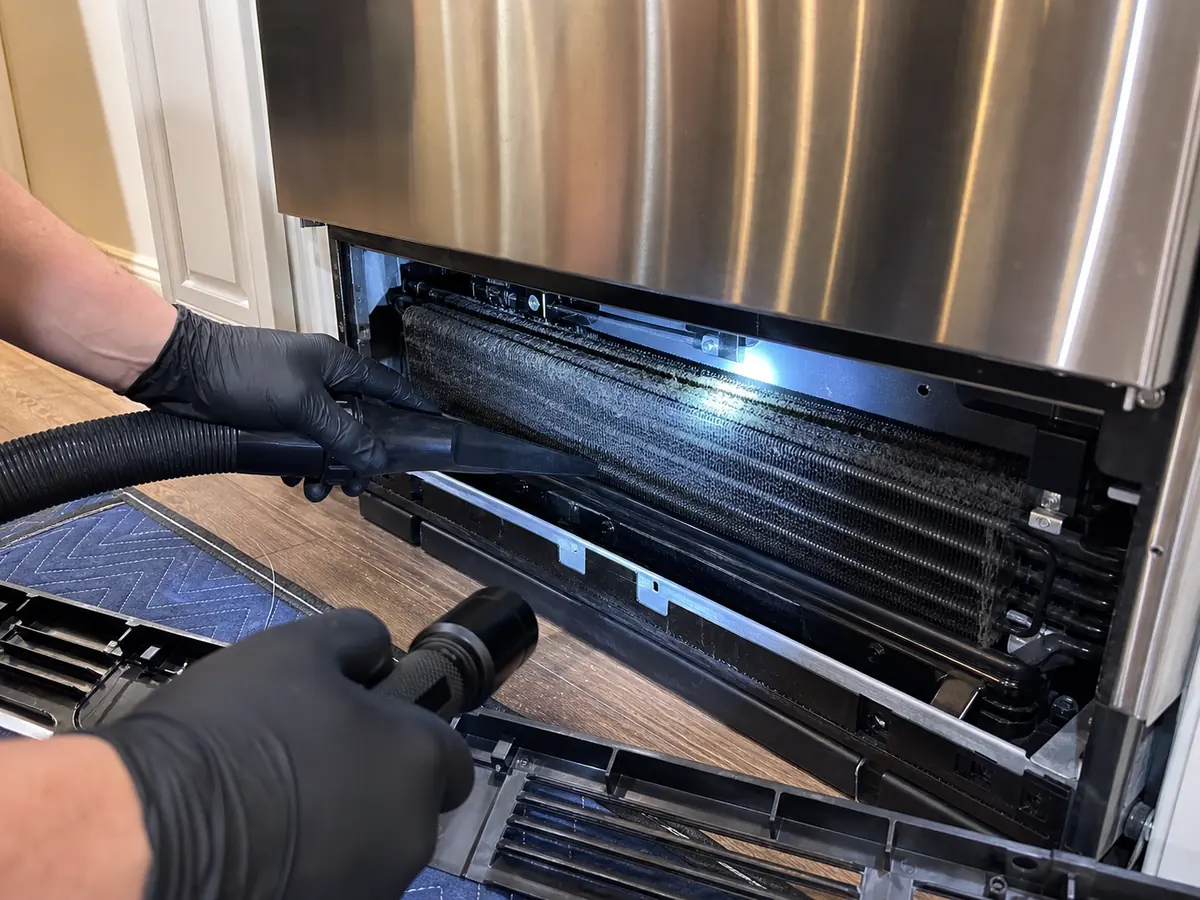
A built-in Sub-Zero breathes through a condenser behind the upper grille. In a dry inland kitchen that coil stays clean for years. In Foster City it pulls in air carrying fine salt aerosol and lagoon moisture, and that combination is corrosive — it settles on aluminum fins and the condenser fan, and over a few seasons it insulates the coil and stiffens the fan bearing. The compressor then runs longer and hotter to hold temperature, which is the first thing we measure on a service call here.
Many Foster City homes are open-plan with the kitchen opening onto a lagoon-facing great room, so the door line sees swings in humidity every time the slider opens. Door gaskets that seal cleanly in a sealed inland house start to sweat and frost earlier here. A gasket that no longer pulls flush lets warm, damp air creep in, the unit works harder, and condensation collects where you do not want it.
Because of the salt load, we suggest a condenser cleaning and fan check twice a year for waterfront homes rather than the usual once. Pair it with a gasket inspection and a quick look at the drain line. None of it is dramatic, but on the lagoon it is the single best way to keep a sealed-system repair off your calendar. Call us or book online and we will set a cadence that fits how close to the water you sit.
Not if you stay ahead of it. The salt and humidity accelerate coil loading and gasket wear, but a twice-a-year condenser clean for waterfront homes offsets nearly all of it.
Once a year inland in the city, twice a year for homes right on a lagoon finger or near the levee, where salt air reaches the condenser most.
Have the failing compartment and model number ready, and you will get a real first opinion — not a sales pitch.